Buying guide · Published
Security screen door colors: the ten standard options, and how to pick one
Ten frame colors, one flat price, and a rule of thumb that settles most of them in a minute.
The short answer: our security screen doors come in 10 standard powder-coat frame colors, Black, White, Almond, Adobe, Brown, Bronze, Sahara Brown Metallic, Sahara Gray Metallic, Light Grey, Silver Metallic, and every one of them is included in the flat installed price of $2,475 for a hinged door, $2,675 for a slider and $4,475 for a French pair. The rule of thumb that settles most choices: match your window frames or entry trim, not your front door. Custom matches to a paint or HOA color are quoted separately, in writing. The finish carries a 10-year manufacturer powder-coating color warranty on mesh and panels; 1 year on hardware, and we bring real samples to the measure because on-screen swatches are approximations.
Color is the decision most people put off, and the one that takes least time once the samples are on the wall. Much of what comes up when you search it is written for Australia or for painted iron grilles, and neither helps someone standing on a stucco porch in Tustin holding a phone. This is the guide for that porch: the ten colors, what each one does next to real trim, what the photos on our own installs show, and the two places where the choice has consequences beyond looks, the HOA packet and the coast.
The ten standard colors
These are the Vista Security Screens standard powder-coat colors, verified against Vista's own site in July 2026, and they are the same ten you will find on our pricing page. Three are metallics with a slight sheen; the other seven are flat architectural finishes. Every frame we install is powder-coated, and every one of these is included in the price with no upcharge.
- Black
- White
- Almond
- Adobe
- Brown
- Bronze
- Sahara Brown Metallic
- Sahara Gray Metallic
- Light Grey
- Silver Metallic
All ten standard colors are included in the flat price - no upcharge for any of them. On-screen colors are approximations; we bring real powder-coated samples to your measure so you can hold them against your trim and your light. Need an exact match to an HOA scheme or existing paint? Custom color matching is quoted separately, in writing.
The swatches above are screen approximations. The table is the more useful part: where each color tends to blend into what is already on the house, and where it reads as a deliberate trim line instead. Both are legitimate outcomes; the point is to choose one on purpose. This is guidance from our own installs, not a manufacturer specification.
| Color | Finish | Where it tends to blend in | Where it reads as trim |
|---|---|---|---|
| Black | Flat | Dark trim, bronze or black window frames, iron railings | Light stucco, where it reads as a deliberate dark outline |
| White | Flat | White vinyl windows, white trim, light stucco | Dark or saturated walls, where it reads as painted trim |
| Almond | Flat | Cream and off-white stucco, almond window frames | Darker earth-tone walls |
| Adobe | Flat | Tan and sand stucco, Spanish and Tuscan palettes | Cream walls, where it warms the opening |
| Brown | Flat | Brown trim, wood-tone entry doors, brick | Light walls, where it frames the entry like stained wood |
| Bronze | Flat | Bronze window frames, dark brown trim, Spanish tile porches | Pale stucco, as a soft dark outline |
| Sahara Brown Metallic | Metallic | Warm gray-brown trim and stone | Light walls, with a slight sheen |
| Sahara Gray Metallic | Metallic | Gray trim, gray-green stucco, slate | White walls, as a muted outline |
| Light Grey | Flat | Gray stucco, light gray trim, silver window frames | Darker gray or blue-gray walls |
| Silver Metallic | Metallic | Aluminum window frames, contemporary gray palettes | Dark modern walls, where it reads as a metal detail |
Frame reads as trim, mesh reads as tint: how a color decision actually works
The thing to understand before choosing is that you are choosing a frame color, not a door color. A security screen door is two visual parts. The frame is the powder-coated border, and it is the only part that comes in the ten colors. The mesh is woven 316 stainless, and it reads as a dark panel in every installed photo we have, whatever frame surrounds it. From a few feet away a fine dark mesh reads like a light window tint: the daylight and the view stay, with a slight cut in glare. A pale mesh would read as a solid sheet, which is why the mesh stays dark whatever the frame color.
So the question "what color should my security screen door be" is really "what color should the border around a dark tinted panel be", and the answer is whatever the border around your other openings already is. Picked well, the frame reads as trim and the mesh reads as tint, and people looking at the house see a door rather than a screen. That is the whole method, and the sections below are just that method applied to the houses Orange County is actually made of.
Match the trim or match the door?
The trim. The instinct is to match the front door, because the screen sits directly in front of it, but the screen door lives in the plane of the door surround and the window frames, and that is the plane the eye reads it in. A frame in the trim color looks like original architecture. A frame in the front door color puts a second block of that color in front of the first, and if the entry door is red or teal or a stained wood, that is a lot of one thing. Your front door keeps its color behind the mesh; it does not need help.
The other instinct, matching the wall, is the one our HOA guide tells you to resist, and for the same reason. A frame that matches the stucco field can look like an attempt to hide something. A frame that matches the trim looks like it was always there, which is also what makes it the easy application in front of an architectural committee. If your house has no visible trim, white vinyl or bronze aluminum window frames are the trim, and they decide it.
White on stucco
White is the color in most of our gallery photos, and it is the default for a house with white windows and light walls. The pattern holds across very different stucco colors. Our gallery has a white hinged door on a peach stucco porch, a white hinged door on a covered back entry beside a single-hung window, and a before-and-after pair where a plain solid entry door on gray stucco became the same entry with a white full-view door in front of it. In each case the white frame lines up with white windows nearby, and the dark mesh sits inside it like a tinted pane.
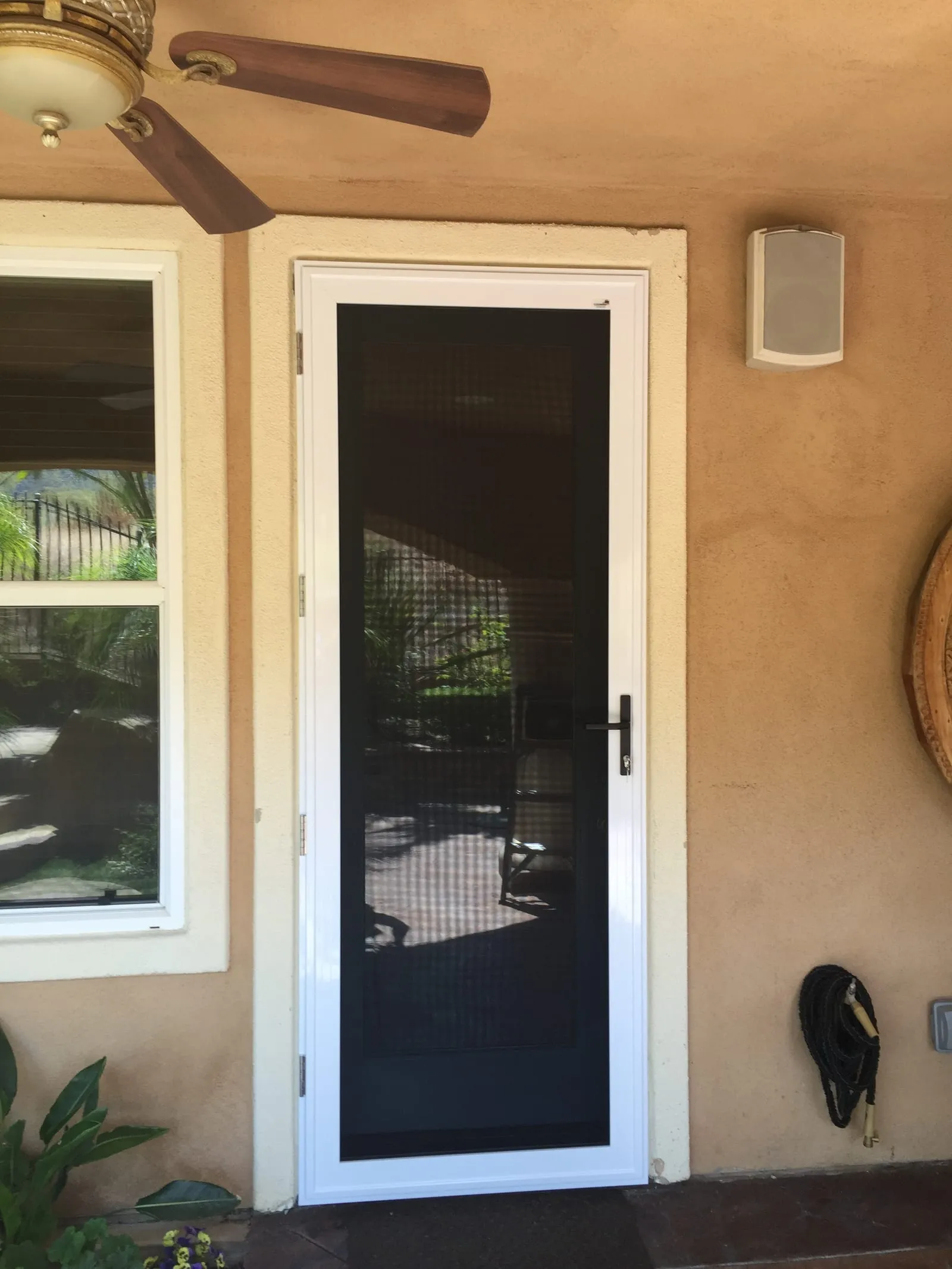
The one case where white is the wrong default is a house whose windows are bronze or black. There, a white frame draws a bright outline around a dark panel on an elevation that has no other white line on it, and it looks added. That house wants bronze or black.
Almond and adobe on cream and tan houses
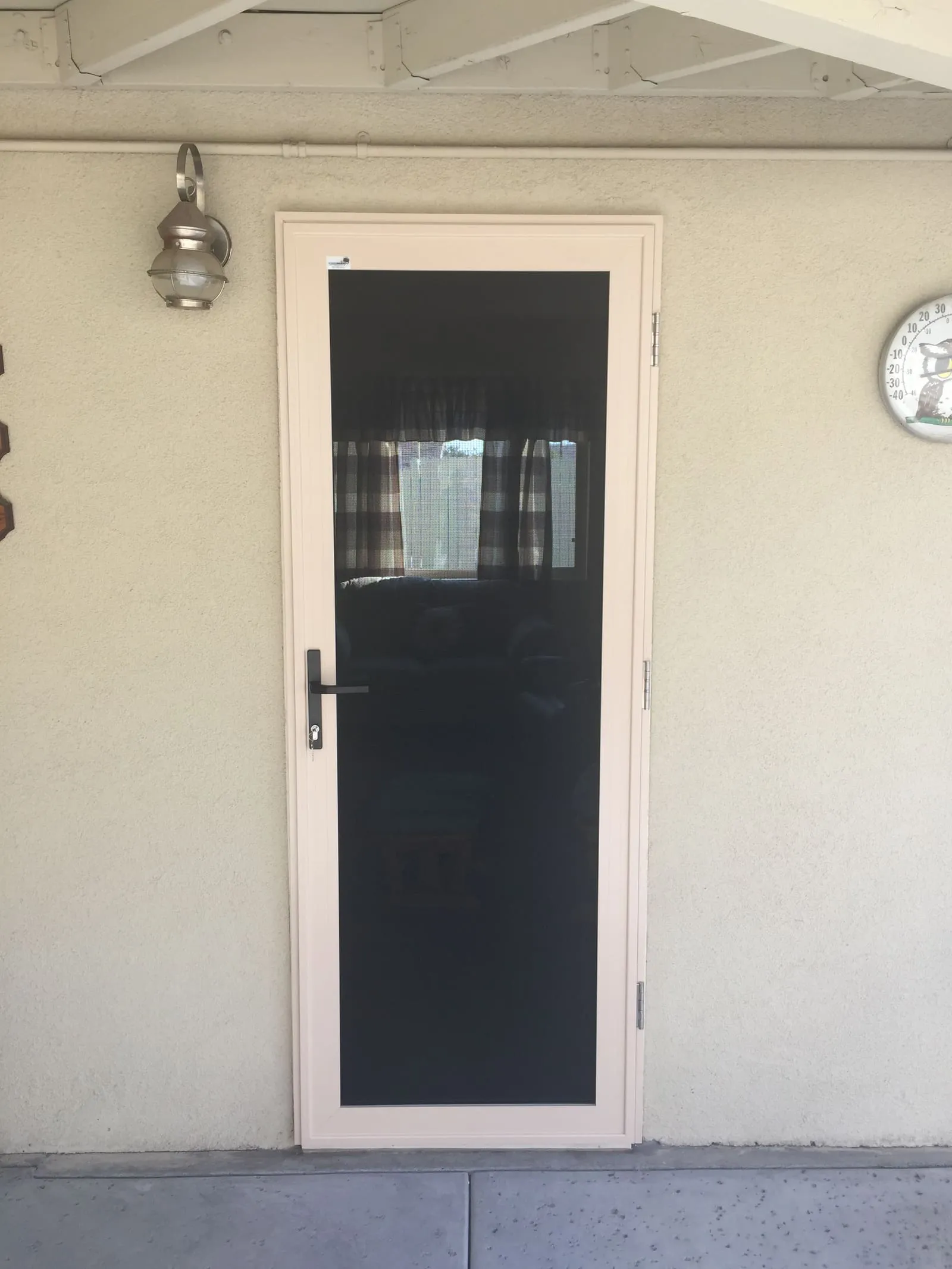
Warm stucco is where pure white can look a half-step too cold. Almond is a soft off-white and adobe is a shade deeper into tan, and both sit more quietly on cream and sand walls, especially where the windows are almond-framed rather than bright white. Our gallery shows an almond hinged door on a cream stucco entry, with a plaid curtain visible through the mesh, and an almond hinged door in front of a ten-lite glass door, where the glass door shows clearly through the mesh when it closes behind the screen. Neither frame announces itself; the eye goes to what is behind the mesh.
A quick trick if you cannot tell whether your walls are warm or cool: hold a sheet of plain white printer paper against them in daylight. Walls that make the paper look bluish are warm, and almond or adobe will blend; walls that make the paper look yellowish are cool, and white or light grey will.
Bronze, brown and black on Spanish tile, brick and dark trim
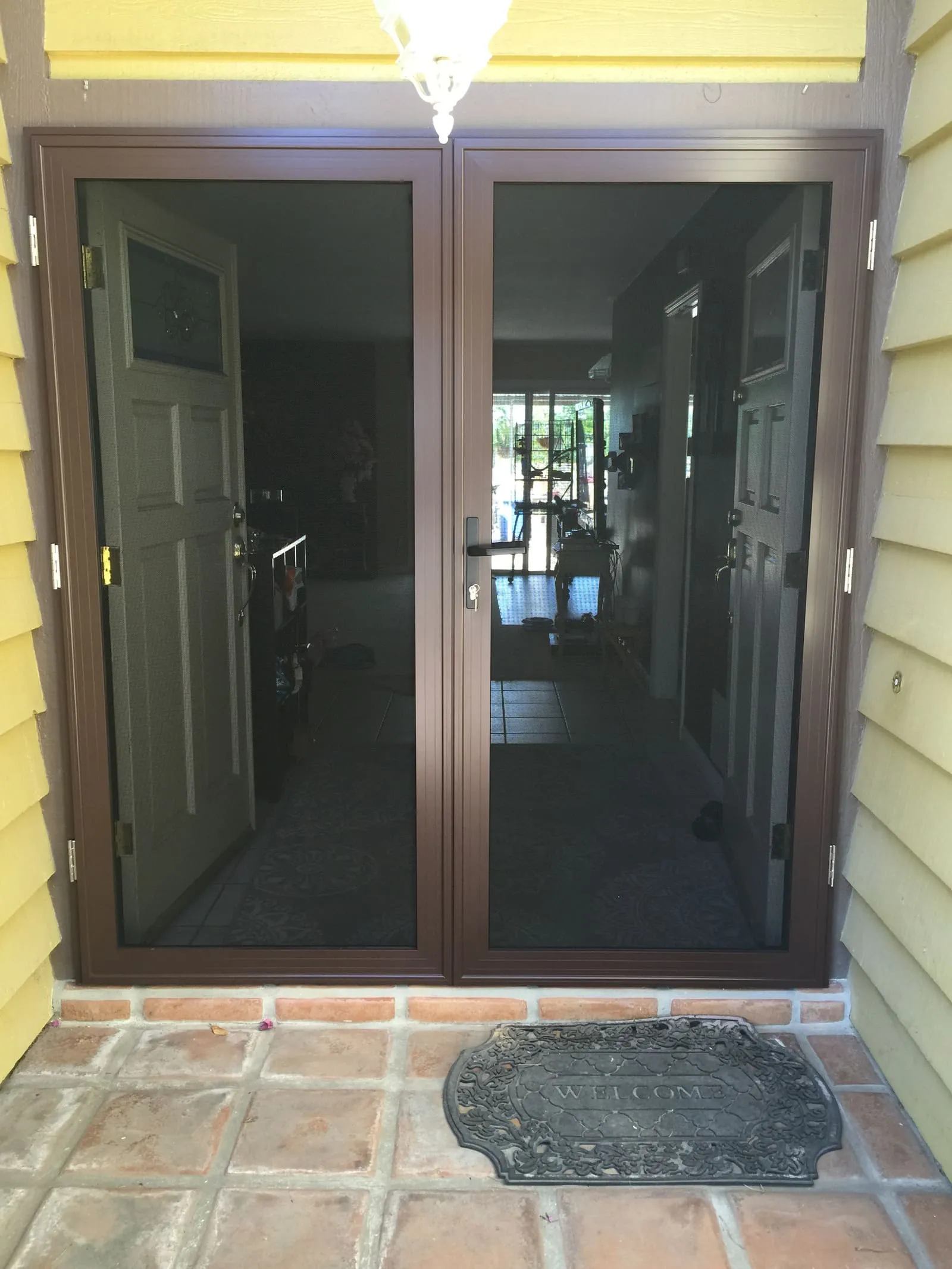
Dark frames belong on houses that already have a dark line in them: bronze window frames, brown fascia, iron railings, a brick step, a Spanish-tile porch. Our gallery has a dark bronze hinged door on a family porch, with a welcome mat and toys in the frame, and a dark bronze French pair on a Spanish-tile porch. Bronze is the more forgiving of the three because it carries a little warmth and sits between brown trim and black iron without arguing with either. Brown belongs with wood-tone doors and brick. Black is the crispest of the three and suits modern dark trim best.
Dark frames and the view-through effect
Because the mesh is dark, a dark frame and the mesh tend to merge into a single quiet panel, which is why our HOA guide notes that darker frames tend to let the mesh visually disappear. The practical effect is on the view. From inside, the view out through the mesh is clear in any frame color; from outside, a dark frame around dark mesh is the combination that draws least attention to the door at all. A white frame is a border you notice, then look through. Neither is wrong, and the choice usually follows the trim anyway, but if the elevation could take either, the dark frame is the one that reads as "nothing to see here".
Two related questions that are not about color. Can you see through it at all: yes, and our see-through guide answers it from inside and out, while the worth-it guide covers what it looks like from the street. Can people see in at night: that depends on where the light is, not on the frame color, and our open-door sleeping guide works through the daylight-versus-lit-interior flip.
Matching an HOA color scheme and custom colors
Color is where most architectural approvals are actually decided, and it is the easiest part to get right. Every in-home measure includes a submission packet, and the powder-coat color chip in it is the exact chip the committee sees. If your association publishes an approved palette or design standards, bring them to the measure and we match against them on the spot; one of the ten usually lands inside the palette. If the association requires a specific paint color that none of the ten matches, custom color matching is quoted separately, in writing, before you submit anything. No one can promise what a board will decide, but a written objection is almost always a color or profile note, and California Civil Code 4765 requires a disapproval to be explained in writing so you can answer it with an alternate frame color and resubmit. The whole process, board by board, is in our HOA approval guide.
Two things about custom matches worth knowing before you ask. A custom color can move your build window, which for standard colors runs 3 to 4 weeks per Vista's factory FAQ as of July 2026, and the written quote states your own window. And in our experience the trim color that seemed to need a custom match is very often within a shade of one of the ten once real samples are held against it, so ask for the samples before you ask for the quote.
How the color holds up near the coast
The color is a powder-coat finish on the frame, and the written terms that come with every quote are a 10-year manufacturer powder-coating color warranty on mesh and panels; 1 year on hardware. That covers the finish. What the coast does to it is cosmetic: dried salt spray reads as a faint pale film, which shows a little sooner on dark powder coat than on white or tan, and it rinses off with a garden hose at normal pressure. Powder-coat care guides warn against pressure washers up close and against harsh solvents and acidic or alkaline cleaners, and none of those is needed. If you love the black frame in Newport Beach or San Clemente, have the black frame and point the hose at it a little more often. The full five-minute routine is in our coastal cleaning guide.
Choosing at the measure: real samples against your trim in your light
Everything above is a way to arrive at the measure with a short list rather than a decision, because the decision should be made with the samples on the wall. The in-home measure is $25 to book, credited in full to your order, and takes about 45 minutes. Part of that time is holding real powder-coated frame samples and a piece of the mesh against your trim, your stucco and your window frames, in the light your porch actually gets. A metallic that looks silver on a phone can read warm gray in afternoon sun; an almond that looked beige can disappear into a cream wall. That is the whole reason the swatches on this page carry a note saying they are approximations. If you want to see more installed doors first, the gallery shows each of the photos described here at full size, and the installation guide covers what happens after you pick.
Color questions
The things people ask with a paint chip in hand
What colors do security screen doors come in?
Ours come in 10 standard powder-coat frame colors: Black, White, Almond, Adobe, Brown, Bronze, Sahara Brown Metallic, Sahara Gray Metallic, Light Grey, Silver Metallic. Three of those are metallics and the rest are flat finishes. Every one is included in the flat installed price, $2,475 for a hinged door on our pricing page, and we bring real powder-coated samples to the in-home measure so you choose against your own trim in your own light rather than from a screen.
Does a color cost extra?
No. All 10 standard colors are included in the flat price, so a hinged door is $2,475 installed in black, white, almond or any of the others, a slider is $2,675, a French pair is $4,475, and window screens start at $825 by glass size. The only color that carries a separate price is a custom match to a paint or HOA color outside the ten, which is quoted separately, in writing, at the measure.
Should the screen door match my front door or my window frames?
Match the window frames or the entry trim, not the front door. The screen door sits in the same plane as the trim around it, so a frame in the trim color reads as part of the original architecture, and your front door keeps its own color behind the mesh. Matching a red or teal entry door puts a second block of that color in front of the first, which is louder than most people want.
What color security screen door looks best on a stucco house?
Look at the window frames before the wall color, because that is what the eye is already used to reading as trim. On the houses in our gallery, white sits well on peach, gray and green stucco, almond sits well on cream stucco, and dark bronze sits well on a Spanish-tile porch. When the stucco and the trim are both light, almond or adobe blends more softly than pure white on warm walls, and light grey does the same on cool gray walls.
Is white or black better for a security screen door?
Neither is better, they do different jobs. Black or bronze frames tend to let the dark mesh visually recede, so the whole door reads as one quiet dark panel and the view through it is at its cleanest; they suit dark trim and dark window frames. White reads as painted trim and belongs on houses with white windows and light walls, where a black frame would draw a hard outline. Near the beach, dried salt spray shows a little sooner on dark powder coat than on white or tan; it is cosmetic and rinses off with a hose, as our coastal cleaning guide explains.
Is the mesh itself black, or does it come in colors too?
The color choice is a frame choice. The mesh is woven 316 stainless and reads as a dark panel in every installed photo we have, whatever the frame color around it. That is by design: from a few feet away a dark fine mesh reads like a light window tint, so the daylight and the view stay, while a light-colored mesh would read as a solid sheet. So when you choose almond or white, you are choosing an almond or white frame around dark mesh. Our worth-it guide covers what that looks like from the street.
Can you match the color my HOA requires?
Usually one of the ten standard colors lands inside an association palette, and every in-home measure includes the HOA submission packet with a powder-coat color chip, the exact chip the committee sees. If your association requires a specific paint color outside the ten, we quote a custom match separately, in writing, before you submit. No one can promise what a board will decide, but a fine-mesh door in a trim-matched color is the application boards approve most readily, and California Civil Code 4765 requires any disapproval to be explained in writing. The full process is in our HOA approval guide.
Will the color fade in the sun near the beach?
The finish is a powder coat on the frame, and the written terms are a 10-year manufacturer powder-coating color warranty on mesh and panels; 1 year on hardware. That warranty covers the finish, and the care it expects is a freshwater hose rinse, which also removes the pale salt film that shows sooner on dark frames near the coast. Powder-coat care guides warn against pressure washers up close and against harsh solvents, and both are easy to avoid. The whole routine is in our coastal cleaning guide.
Can I see real samples before I choose?
Yes, and you should. The on-screen swatches on this page and on our pricing page are approximations, because a powder-coated frame in afternoon sun looks nothing like a hex value on a phone. The in-home measure, $25 to book and credited in full to your order, is where we hold real powder-coated frame samples and a piece of the mesh against your trim, your stucco and your window frames in your own light. Most people decide in a couple of minutes once the samples are on the wall.
What if the color I want is not on the list?
Bring the paint chip, the trim sample or the HOA color code to the measure. Custom color matching is available and is quoted separately, in writing, so you know the number before anything is ordered. Two honest notes: a custom color can move your build window, which is 3 to 4 weeks per Vista's factory FAQ as of July 2026 for standard colors, and in our experience the trim color that seemed to need a custom match is very often within a shade of one of the ten once the real samples are on the wall.
Pick the color with the samples on your wall.
The in-home measure is $25 to book, credited in full to your order. We bring all ten frame colors and a piece of the mesh, and the written quote matches the published price in any of them.
5.0 on Google · 2 reviews as of October 2026 · read them
Get your quoteOr just call (657) 695-2454 - or text us a photo of your opening and we'll reply with the number.