Process guide · Published
Security screen door installation, start to finish
Two visits, under two hours of work at your house, and a doorway that ends the day the same size it started.
The short answer: installing a security screen door is a two-visit job with nothing structural in it. The in-home measure takes about 45 minutes, fabrication typically runs 3 to 4 weeks per Vista's factory FAQ as of July 2026, and install day is usually under two hours per door. The frame fastens to the door jamb your existing door already hangs in, not to the wall surface, so stucco, brick, block and siding entries are all routine and the opening stays the size it was. Most Orange County homeowners never pull a permit for one, though the city decides that and HOA architectural approval is a separate process. Installed prices are flat and published: $2,475 for a hinged door, $2,675 for a slider, $4,475 for a French pair.
Almost everything published about installing a security door is written by somebody selling the door, and it stops at the price. The questions homeowners actually stall on come later: what gets drilled, how long strangers are in the house, whether the stucco survives, and what happens if the thing is damaged in year three. Here is the whole sequence, including the parts that are inconvenient to us.
Visit one: the measure, about 45 minutes
Booking holds a slot for $25, and every dollar of it comes off your order when you buy. We call or text within 48 hours to set a time, and the visit happens within seven days of booking. On the day we walk the openings you care about, measure each one to the millimeter, and put real mesh and frame samples against your own paint in your own light, which is the part that decides color for most people. Before we leave you have a written itemized quote matching the flat prices already published on our pricing page.
The measure is also the survey. Width and height each get taken in three places, and when those six numbers disagree by more than about a quarter inch the opening is out of square - common in older houses here, and handled at fabrication rather than treated as a problem. Bowed jambs, settled thresholds and openings that were never standard all get found in those 45 minutes rather than on install day, which is the entire reason the visit exists when the price is already public.
The gap in the middle: 3 to 4 weeks
Nothing happens at your house while your door is built. Fabrication typically runs 3 to 4 weeks per Vista's factory FAQ as of July 2026, and your written quote states your own build window, because it moves with the factory queue and with the color you chose. We confirm the install date as fabrication wraps. There is no deposit schedule to manage in the meantime and nothing for you to prepare.
Visit two: install day, hour by hour
One crew, our own employees rather than subcontractors, and for a single hinged door the whole thing is usually done inside two hours. A French pair or a patio slider typically takes a morning. What that time is actually spent on:
| Stage | What happens | What you do |
|---|---|---|
| Arrival | The door comes out of the truck wrapped, gets unwrapped and checked against your quote for size, color and hardware before anything touches the house | Confirm it is the color you picked. Say something now if it is not |
| Prep | The opening is cleared and the old screen door, if there is one, comes off. Drop protection goes down inside the threshold | Move anything breakable near the entry, and pen the dog somewhere |
| The hang | The frame is set into the jamb, plumbed, and fastened through the jamb into the framing behind it | Nothing. This is the loud part, and it is short |
| Squaring and tuning | The door is adjusted until it swings and latches with one finger, and the closer is set so it does not slam | Nothing |
| Locks and keys | Every lock is cycled and keyed, and any bedroom-window screen release is tested | Work the lock yourself before we leave. Twice |
| Walkthrough | Care, cleaning and warranty terms in plain language, plus any powder-coat touch-up where a tool marked the finish | Ask about the touch-up if nobody mentions it |
| Cleanup | Packaging, offcuts and the old screen door leave with us on request | Say if you want the old door kept |
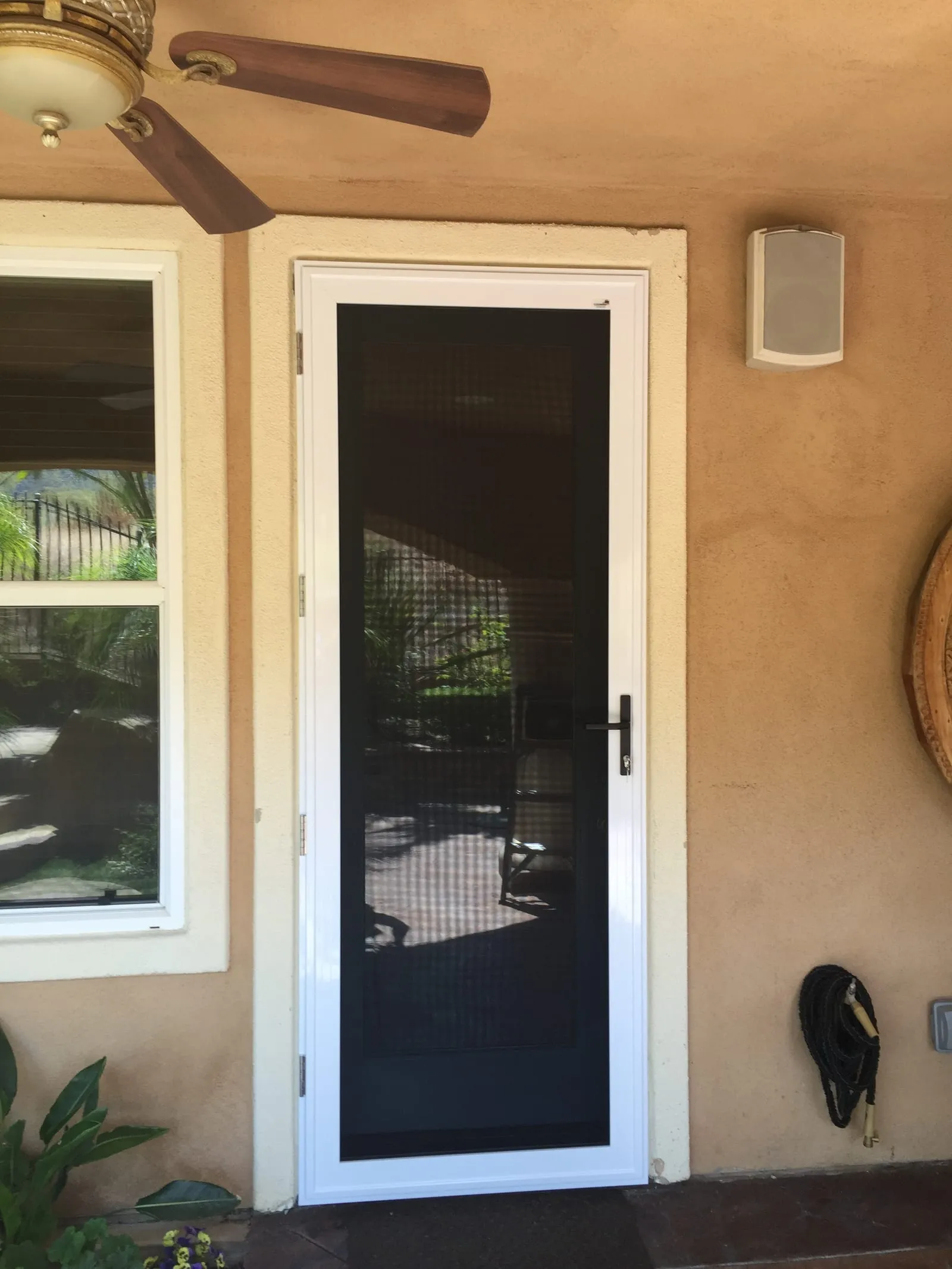
What it fastens to, and why nobody cuts your stucco
This is the question that stalls Orange County homeowners more than any other, because nearly every house in the county is stucco and the search results for it are DIY forum threads and a big-box surface-mount instruction sheet. The answer is that a security screen door does not attach to the wall surface at all. It fastens into the door jamb, the structural frame your existing door already hangs in, with fasteners running through the jamb into the framing behind it. Vista's own installation specs call for heat-treated steel screws driven into studs rather than into drywall and hope, which is the difference between a door that resists force and a door that pulls out of the wall carrying its own fixings.
The consequences are worth stating plainly, because they are what the question is really asking. The stucco field around your opening is not cut, drilled through, patched or re-textured. The opening is not resized, so no header moves and no framing changes, which is also why a permit is usually not in play. Brick, block, tile and siding entries work the same way for the same reason: the jamb is the anchor in all of them.
What changes about your house, and what does not
What changes: there is a second door in the opening, it swings the way you chose at the measure, and it is locked separately from your entry door. Your entry door keeps working exactly as it did and can stand open behind the screen, which is the entire point of the purchase.
What does not change: the size of the opening, the entry door itself, its weather seal, its hardware and its threshold. Nothing is removed except an old screen door if you had one. If your entry door is due for replacement, that is a sequencing question rather than a conflict, and it is covered below.
Taking it off again, if you ever want to
It comes off. The door is fastened to the jamb rather than built into the wall, so removal is an unscrewing job that leaves fastener holes in the frame to fill, not construction to undo. That is worth knowing for three separate reasons. Sellers sometimes ask, and in Southern California a quality security screen is increasingly listed as a feature rather than removed before listing. Renters need it, because the door attaches to the landlord's frame and the honest answer is to get written permission first. And anyone comparing this against window bars or a wrought iron gate should weigh how much harder those are to reverse.
One correction, because the internet gets this wrong in a way that costs the whole category sales: the advice that security doors go in with one-way screws and are "virtually impossible to remove" is written about burglar bars and grille doors. It is not a description of a screen door hung in a jamb.
If it gets damaged in year three
The repair path for a security screen is not the repair path for an insect screen, and the search results conflate them completely. An ordinary screen is mesh rolled into a groove with a rubber spline, which is why a mobile screen van can re-roll one in your driveway in twenty minutes. Security mesh is a woven 316 stainless panel clamped into a rigid frame. There is no spline to pull and no roller step, so the driveway rescreen does not apply, and every instruction in the winning answer online is wrong for this product.
What actually happens is one of two things. Warranty first: the written terms are a 10-year manufacturer powder-coating color warranty on mesh and panels; 1 year on hardware, which covers the finish and the components rather than accidental damage. Everything else is a repair we quote - a door someone reverses into is not a warranty claim, and we would rather say that here than at your house. Because the panel is a manufactured component in a system, a damaged panel is replaced rather than patched, which is slower than a rescreen and considerably more permanent. The maintenance that prevents most of it is genuinely a freshwater rinse, covered in our coastal cleaning guide.
Remodeling, painting, or replacing the entry door? Sequence the screen last
The screen is fabricated to the opening as it exists on measure day, so anything that changes the jamb has to happen first: a new entry door, a re-framed opening, stucco repair, or trim work that changes the reveal. Paint is the one that catches people, and in both directions. Painting the trim after installation means cutting in around a fitted frame, and choosing your powder-coat color before the trim color is settled means matching to something provisional. If a project is in flight, book the measure for after the jamb is final. The full measuring guide works through what "final" means for each kind of work.
Permits and HOA approval, briefly
Building permits attach to work that changes the structure: resizing an opening, moving a header, replacing a jamb. A security screen door does none of those, which is why most Orange County homeowners never pull one. Your city building department is still the authority and one call settles it in a couple of minutes. HOA architectural approval is a different process entirely, required far more often than a permit, and if you are in a south county association you should assume you need it - our HOA approval guide covers the boards by name and what a submission packet contains. If a screen is going over a bedroom emergency escape window, the release rule in California egress code applies regardless of whether a permit does.
Install questions
The things people ask on the doorstep
How long does a security screen door installation take?
Under two hours per door on site for hinged work, and usually a morning for a French pair or a slider. That is install day only. The full timeline from booking is about 45 minutes for the in-home measure, then 3 to 4 weeks of fabrication per Vista's factory FAQ as of July 2026, with your exact build window stated on the written quote because it moves with the factory queue and your color choice.
Will the installers drill into my stucco?
No. The frame fastens into the door jamb, the structural frame your existing door already hangs in, with fasteners running through the jamb into the framing behind it - Vista's own installation specs call for heat-treated steel screws driven into studs rather than into drywall. The stucco field around the opening is not cut, patched or re-textured. This is the single most common worry we hear in a county built almost entirely in stucco, and the answer is the same on brick, block and siding entries.
Do I need to be home for the install?
Yes, for the start and the finish at minimum. We need access to the opening, and the walkthrough at the end is where you get the keys, cycle the lock yourself, and hear the care and warranty terms. Nothing in between requires you to hover - most people carry on with their day in the next room.
Can I install a security screen door myself?
Our prices are installed prices, so we do not sell a panel for you to hang. The reason is not upselling: a woven-mesh security door performs to its test reports only when it is measured to the opening, hung square and fastened into structure, and every one of those three is a site skill rather than a product feature. A door hung a quarter inch out of square binds, wears its hardware early, and puts load on a lock that was never meant to carry it.
What if my opening is out of square or the jamb is in poor shape?
Both are found at the measure, not on install day, which is most of what those 45 minutes are for. Out-of-square openings are common in older Orange County houses and are handled at fabrication rather than being a problem: the door is built to the opening you actually have. A jamb that is soft, split or badly out of plumb is a different case, and we will say so at the measure rather than after the door is built. The six-measurement test that tells you which one you have is in our measuring guide.
If I take it off later, what does it leave behind?
Fastener holes in the jamb to fill, and that is the extent of it. The door is fastened to the frame rather than built into the wall, so removal is an unscrewing job rather than construction. That matters if you are weighing this against window bars or a wrought iron gate, which are considerably harder to reverse, and it is worth knowing because the answer you will find online is written about one-way security screws used on burglar bars.
Can a mobile screen company repair it later?
Generally not, and it is better to know that before you buy than after. A security screen is a woven 316 stainless panel clamped into a rigid frame, not an insect screen rolled into a groove with a spline, so the driveway rescreen that fixes an ordinary screen door does not apply to it. Damage runs one of two ways instead: the written terms are a 10-year manufacturer powder-coating color warranty on mesh and panels; 1 year on hardware, which covers the finish and the components rather than accidental damage, so a door someone reverses into is a repair we quote rather than a warranty claim.
Do you take the old screen door away?
On request, yes, and it is included rather than a line item. If you would rather keep it - people do, for a rental or a shed - we leave it where you want it.
Do I need a permit, and does the HOA need to approve it?
Usually no permit, because a security screen door mounts to the frame that is already there and leaves the opening as it was, but your city building department decides and one call settles it. HOA architectural approval is a separate process from a permit and is required far more often than a permit is, especially in south county - our HOA approval guide covers the boards by name. Screens over bedroom emergency escape windows carry their own rule, worked through in our California egress guide: the screen must release from inside without a key, tool or special knowledge, under Section R319 of the 2025 California Residential Code, Section R310.4 in earlier editions.
Book the 45 minutes that answers all of this for your opening.
The in-home measure is $25 to book, credited in full to your order, and it ends with a written itemized quote.
Get your quoteOr just call (657) 695-2454 - or text us a photo of your opening and we'll reply with the number.