Living-with-it guide · Published
Can you see through a security screen door?
Yes, and here is what the view actually looks like from your side of the mesh, in daylight, at night, and against an ocean.
The short answer: yes, you can see through a security screen door, and from a few feet inside the room the fine woven 316 stainless mesh reads like a light window tint, the way a good insect screen does, with the walkway, the lawn and the street all in plain view. It is not bars and it is not a shade screen, and it does not make the house dark: a room that used to sit behind a shut entry door gains daylight, because the door is now open. We publish no light-transmission percentage because no sourced figure exists for this mesh. Installed prices are flat and published, $2,475 for a hinged door and $825 for a window screen covering up to 8 square feet, and the mesh sample comes to your house at the measure so you can judge it in your own light.
This is the question that blocks more sales than price does, and it deserves a straight answer with photographs rather than an adjective. People picture the security doors they grew up with, a grille of painted bars over a saggy insect screen, and they assume a stronger door means a darker room and a chopped-up view. A woven stainless door is a different object. What follows is what it looks like from inside, why the physics works the way it does, where it genuinely does not (night, with the lights on), and how it differs from the solar screens it keeps getting confused with.
What it looks like from inside
This is the photograph we get asked for at every measure, so here are three of them, all real installs shot from the room side with the screen locked. No customer names, no cities attached, and nothing retouched.
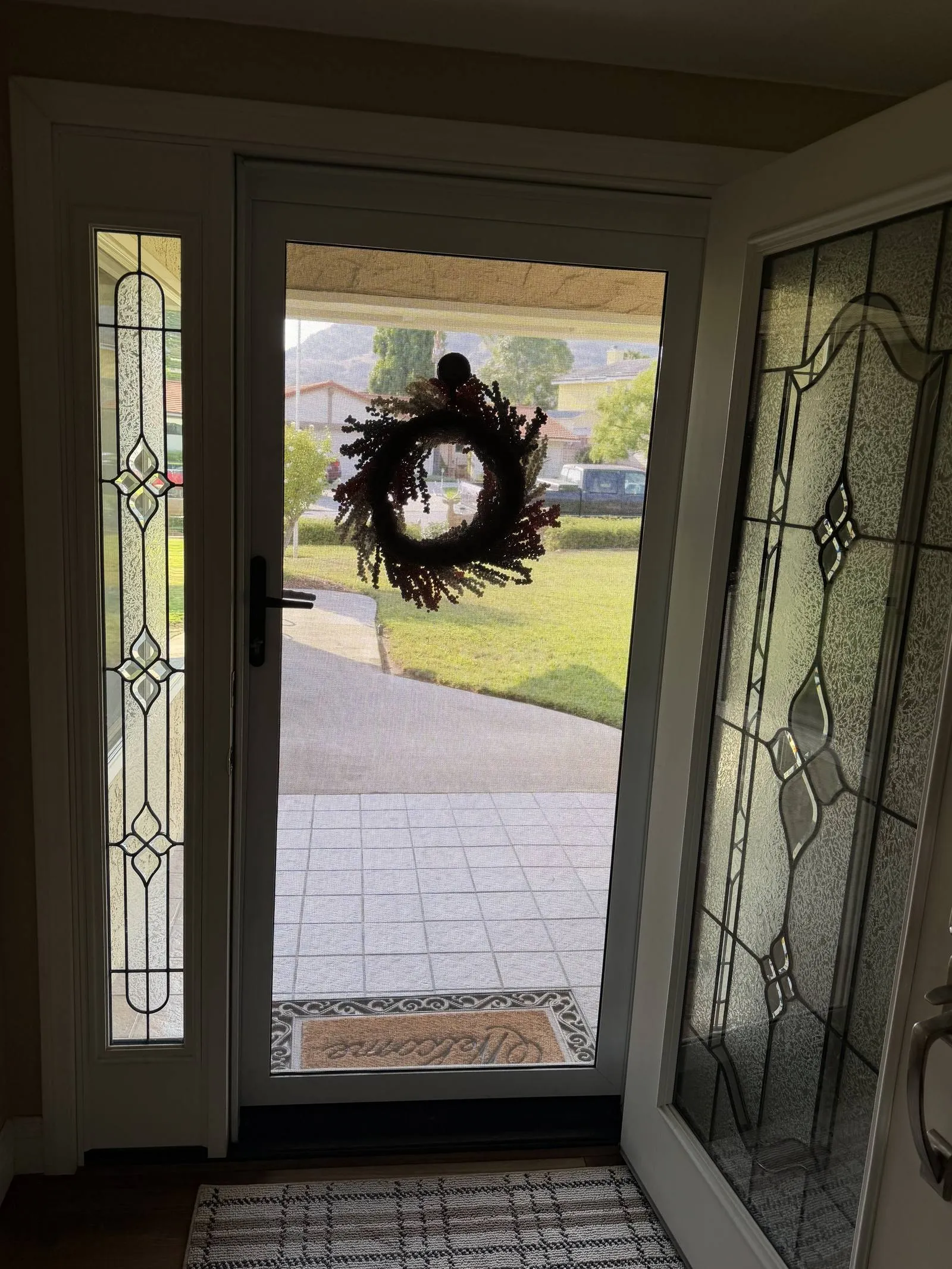
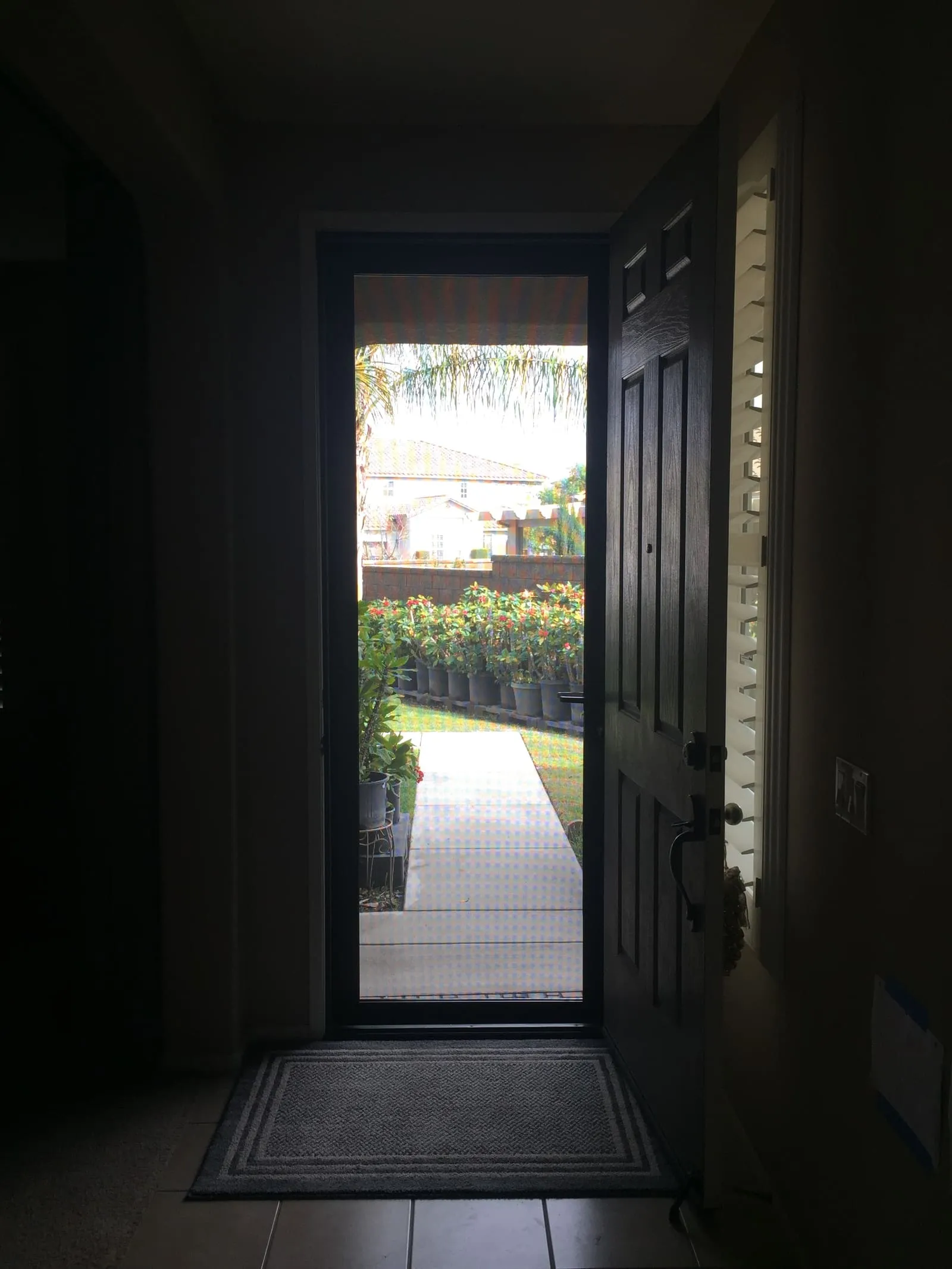
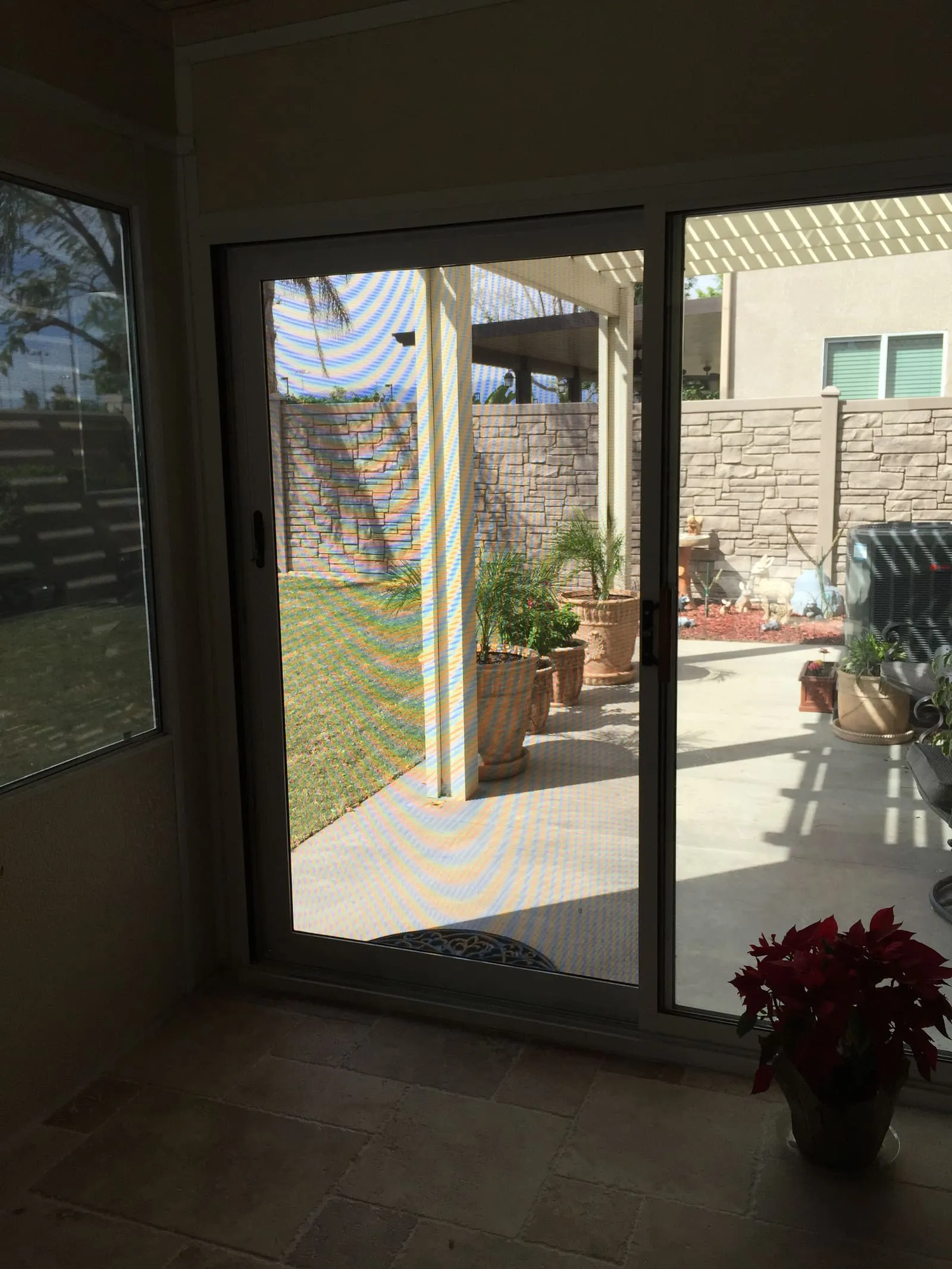
Why dark mesh reads as a tint, and a light mesh would not
The physics is simple and it is the same physics that makes a good window screen vanish. The mesh is dark, it is woven from fine wire, and it sits closer to your eye than anything it could obstruct. Meanwhile the light outside is brighter than the room behind you. Your eye focuses on the bright scene beyond and treats the dark weave as a faint scrim over it, the way you look through a chain-link fence at a ball game rather than at it. A pale mesh would behave the opposite way: light-colored wire catches sunlight and shows up as a surface, which is why a white insect screen is more visible than a charcoal one, and why security mesh is dark on purpose rather than by accident.
Construction matters as much as color, and the three products sold under the words "security door" are built three different ways. Woven mesh is a fabric of individual high-tensile stainless wires clamped into the frame, and it stays near-transparent because there is nothing in it but wire and open weave. Perforated screens are a single punched aluminum sheet, which is less see-through because the sheet is the structure and the holes are the exception. Bars or grilles are a decorative steel pattern fixed over an ordinary insect screen, and you see the bars because you are meant to. Our types guide sorts the three constructions in detail; every door and window screen we install is the first kind.
Will it darken the room?
A little, and less than you would guess. It is a woven screen, so some light is intercepted, exactly as an insect screen intercepts some, and there is no grille or bar pattern to throw shadows across the floor. We do not publish a light-transmission number for the same reason we do not publish an aperture figure: we have no sourced figure for this mesh and we will not estimate one for a web page. What we can tell you is the direction of the effect, and it runs the other way from what people fear. The comparison that matters is not against an empty doorway but against the solid door you currently keep shut, and a closed entry door passes no light at all. Rooms that used to sit behind a shut door gain daylight the day the screen goes in, because the door is now open from breakfast to bedtime. Our window screen page makes the same point for bedrooms, and the honest test is the one we bring to your house: a mesh sample held against your own opening, in your own light.
Security mesh versus solar and shade screen: two different products
Most of the fear that a security screen will darken the house comes from a different product entirely. Solar and shade screens are a category of comfort product engineered to block sun, and they are rated by an openness factor: the darker and tighter the weave, the more heat it stops and the less you can see through it. That is the trade they are designed to make. Woven security mesh makes no such trade, because it is optimized for strength with the view kept whole, and it is not sold as a shading product. Neither is a substitute for the other, and both are good at their own job.
| Question | Woven security mesh | Solar or shade screen |
|---|---|---|
| What it is sold for | Leaving a door or window open with the opening locked; forced-entry resistance with the view kept whole | Cutting sun, glare and solar heat at a window or patio |
| Material | Woven 316 stainless steel wire, clamped into a rigid powder-coated frame with its own lock | Woven shade fabric, typically in a light frame or on a roller |
| Effect on light | A slight tint, similar to a quality insect screen; no published transmission figure for our mesh | Deliberate reduction, rated by openness factor: darker weave, more heat blocked |
| Effect on view | Reads as a light tint from a few feet inside; the view stays whole | Reduced by design; the tighter the weave, the less you see |
| Tested against forced entry | Yes: knife-shear tested to Australian standard AS 5041-2003 | No, and shade-screen makers do not claim otherwise |
| Right tool when | The goal is a door or window that can stand open without a second thought | The goal is a cooler west-facing room in August |
The practical rule: if a vendor uses the word "security" for a retractable or shade product, ask which forced-entry standard it was tested to. And if a vendor attaches a shading percentage to a security screen, ask for the exact mesh and the named test the figure came from. Our bars comparison has a short FAQ on why retractable and solar screens are not security screens at all.
Daylight versus night: the privacy flip
Here is the part most sales pages skip, and it is the part that decides whether the door feels right at nine in the evening. Visibility through mesh follows the light, not the product. In daylight the outside is brighter than the inside, so from the street the mesh reads dark and the view in is limited, while your view out stays clear. Daytime privacy comes free, which is why the doorway can stand open all afternoon with the neighborhood walking past and nobody looking at your hallway.
At night that balance reverses. With interior lights on and the porch dark, someone standing close to the door can see in, the same as through any window or ordinary screen. That is not a flaw in the mesh; it is what light does. The fix is the same one you use for windows: dim the room behind the open door and the mesh goes dark again, or leave the porch light on so the brightness sits on the outside once more. The door stays a locked steel door either way. Our guide to sleeping with the door open works through the whole overnight routine, including bugs and the marine layer.
Glare, sun and the west-facing door
A fine woven mesh shades the opening, so it trims glare and some solar heat gain the way any tight screen does. On a west-facing door in August that is a real comfort difference, and many people tell us they prefer the doorway view with the mesh to the view without it, because the low sun stops bouncing off the tile. Numbers are where this category gets loose. You will see specific percentages for solar heat gain and UV attached to other brands, and those figures belong to the exact mesh and the exact test they came from, not to security screens as a class. Vista publishes no shading or UV figure for the mesh we install, so we do not print one. The longer version of that answer, and the rest of the value question, is in our worth-it guide.
Ocean, harbor and hillside views
The coast asks this question with more at stake, because in Laguna Beach or on the bluff in Dana Point the view is often the most valuable thing the house owns. The answer is a relief. Against the brightness of sky and water the fine dark weave visually falls away, so from a few feet inside the room you are looking at the cove, the harbor or the sailboats rather than at the screen. Corona del Mar owners ask whether they will still see the flower street and the neighbors walking to the beach, and the honest report from our measures is that they do, and that most people stop noticing the mesh within days. The city pages for Laguna Beach, Dana Point and Corona del Mar each carry the local version of the question, and our coastal homes guide covers why the same mesh that keeps the view also survives the salt air.
What it looks like from the street: screen door, not bars
The other half of the aesthetic worry is the curb. From the sidewalk a woven-mesh door reads as a well-made screen door: a slim powder-coated frame around a plane of fine dark mesh that reads like shadow. There is no grillwork, there are no bars, and on glass-forward coastal architecture the effect is closer to a design element than to a security product. Most visitors never register that it is a security door at all, which is also why fine-mesh doors tend to move through HOA architectural review on frame color rather than on the word security, as our HOA approval guide explains. If what you are picturing is a decorative wrought-iron grille, the iron comparison puts the two side by side, and iron genuinely wins on sculptural presence if that is the look you want.
Does frame color change how see-through it is?
Not the mesh, which is dark in every door we install, because dark is what makes it disappear. The color decision lives in the frame, and the frame is the part that is seen from the street. It comes in 10 standard architectural powder-coat colors, verified against Vista's range as of July 2026, every one of them included in the flat price, so the right color for your house is never an upcharge. Picked well, the frame reads as trim and the mesh reads as a light tint inside it, which is why people looking at the house see the door rather than the screen. The full swatch set and the honest note that on-screen colors are approximations are on our hinged door page. The samples we bring to the measure are real powder-coated pieces, held against your own trim in your own light.
See it in your own light: samples at the measure and the gallery
Photographs settle most of this, but the doorway that matters is yours, at the hour you care about. That is what the in-home measure is for. We bring real mesh and frame samples, you hold the weave up against your own opening, and you look through it toward whatever you were worried about losing. Booking the measure is $25, credited in full to your order, and it ends with a written itemized quote that matches the flat prices on our pricing page: $2,475 installed for a hinged door, $2,675 for a patio slider, and $825 for a window screen covering up to 8 square feet. Until then, every install photo we have is in the gallery, including the three above.
View and light questions
What people ask while standing in the doorway
Can you see through a security screen door from inside?
Yes. From a few feet inside the room the fine woven stainless mesh reads like a light window tint: the walkway, the lawn, the street and whoever is at the door all stay in plain view. It looks nothing like bars or a grille. The reason is optics rather than marketing: the mesh is dark and sits closer to your eye than anything it could block, and the light outside is brighter than the room behind you, so your eye focuses through the weave rather than on it.
Will a security screen door make my house dark?
Less than people expect, and far less than the closed door it replaces. It is a woven screen, so some light is intercepted, exactly as an insect screen intercepts some. We do not publish a light-transmission number because we have no sourced figure for this mesh and will not estimate one. The direction of the effect is what matters: a room that used to sit behind a shut entry door gains daylight, because the door is now open with a screen in the opening.
Can people see into my house through the mesh at night?
It depends on where the light is. In daylight the outside is brighter than the inside, so from the street the mesh reads dark and the view in is limited while your view out stays clear. At night that balance flips: with interior lights on, someone standing close to the door can see in, the same as through any window or ordinary screen. If privacy matters at bedtime, dim the room behind the open door and the mesh goes dark again. Our open-door-at-night guide covers the rest of the evening routine.
Will the mesh block my ocean or garden view?
Not in any way that costs you the view. The stainless weave is fine and dark, and against the brightness of sky, water or a sunlit garden it visually falls away, so from a few feet inside the room you are looking at the harbor or the flowerbed rather than at the screen. Bluff-top and cove-view homeowners in Laguna Beach, Dana Point and Corona del Mar ask this at nearly every measure, and the honest answer is that most stop noticing the mesh within days.
Is a security screen the same thing as a solar screen?
No, and the confusion costs people the wrong purchase in both directions. A solar or shade screen is a comfort product engineered to block sun, rated by an openness factor: the darker and tighter the weave, the more heat it stops, and the less you see. Security mesh optimizes for the opposite, strength with the view kept whole, and it is woven 316 stainless clamped into a rigid frame with its own lock. If cutting afternoon heat is the actual goal, a shade product is the right tool. If the goal is a door or window you can leave open without thinking about it, that is the job this product exists for. The three constructions sold as security doors are sorted in our types guide.
Does it cut glare or heat?
Some. A fine woven mesh shades the opening, so it trims glare and some solar heat gain the way any tight screen does, and on a west-facing door in August that is a real comfort difference. Many people prefer the doorway view with it to the view without. What we will not do is print a percentage: Vista publishes no shading or UV figure for the mesh we install, so we would rather give you no number than someone else's. Treat any percentage with no named test behind it as a sales adjective, from us or anyone.
Does a security screen door look like bars from the street?
No, and this is the objection we hear most. There are no bars: the security element is a fine woven mesh panel inside a slim powder-coated frame, so from the curb it reads as a dark screen door rather than as hardware. From the sidewalk the mesh reads like shadow and the frame reads as trim, which is why most visitors never register that it is a security door at all. The side-by-side with grilles and iron is in our security doors versus bars comparison.
Is the mesh black, or does it come in other colors?
The mesh is dark, and dark is the reason it disappears: a pale mesh would catch light and show as a surface, while a dark weave is what the eye looks through. Color choice lives in the frame, which comes in 10 standard architectural powder-coat colors at no upcharge, verified against Vista's range as of July 2026, so the frame is normally matched to your trim and the mesh reads as a light tint inside it. The full swatch set is on our hinged door page.
Are the photos on your site real installs?
Yes. Every photo in our gallery and on this page is a real installed door, shot on site. We do not attach a customer name or a city to any photograph, and where a camera artifact shows, such as the rainbow moire a phone sensor produces when it photographs fine mesh, we say so in the caption rather than retouch it out. Your eye does not see moire; the camera does.
Can I look through a sample before I decide?
Yes, and we would rather you did. We bring real mesh and frame samples to the in-home measure so you can hold the weave up against your own doorway, in your own light, at the time of day you care about. Booking the measure is $25, credited in full to your order, and it ends with a written itemized quote matching the flat prices on our pricing page, with no obligation to decide on the spot.
Hold the mesh up to your own doorway before you decide.
The in-home measure is $25 to book, credited in full to your order, and the samples come with it.
5.0 on Google · 2 reviews as of October 2026 · read them
Get your quoteOr just call (657) 695-2454 - or text us a photo of your opening and we'll reply with the number.