Buying guide · Published · Updated
The types of security screen doors, sorted
Two questions - which opening, and how it is built - decide the whole thing.
The short answer: security screens come in four shapes for four openings - hinged for single entries, sliding for patio sliders, French pairs for double doors, and window screens for the openings you want open at night. Underneath the shape, three constructions matter: woven stainless mesh (the security benchmark), perforated aluminum sheet (mid-range), and a decorative bar or grille over ordinary insect screen (the big-box product). Pick the opening first, then insist on woven marine-grade mesh. A glass storm door is a different product with a weather job, covered in our security screen door vs storm door comparison.
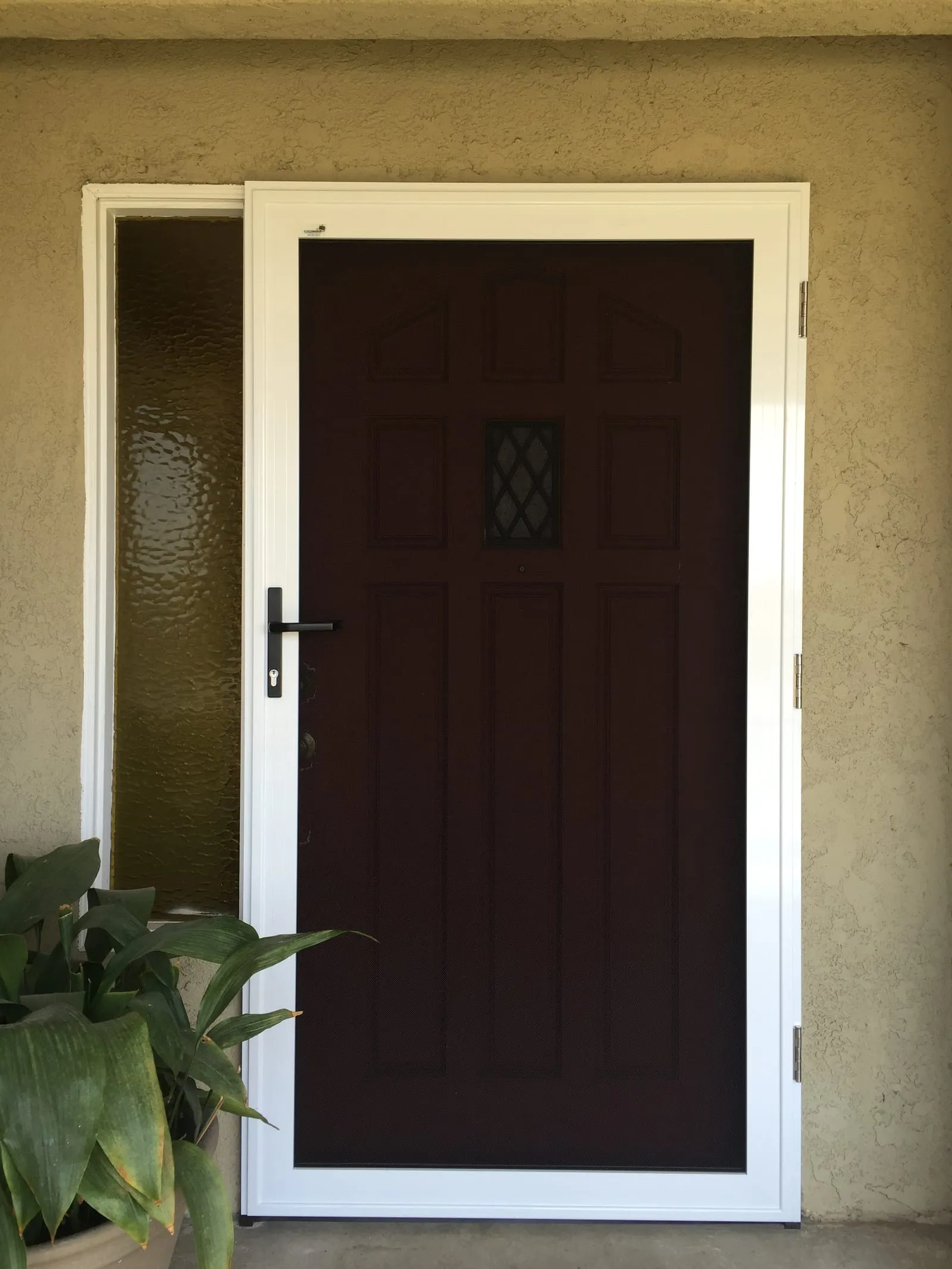
"Security screen door" covers a wider family than most people expect. The word "type" gets used two ways at once - the opening the door serves, and the way the barrier is built - and mixing them up is how a buyer ends up with a good-looking grille that a box cutter defeats. Sort the two questions and the choice gets simple.
Question one: which opening?
This is a measuring question, not a security one. Walk the doors and windows you actually leave open on a warm evening, and each maps to a product.
| Type | The opening it serves | Best for | Our flat price, installed |
|---|---|---|---|
| Hinged door | A single swinging entry | Front doors, side doors, kitchen doors | $2,475 |
| Sliding door | A patio slider opening | Patio sliders, balcony doors, indoor-outdoor rooms | $2,675 per opening |
| French pair | A double or garden door | French doors, double entries, garden doors | $4,475 per pair |
| Window screen | A window you want to open | Bedroom and ground-floor windows | From $825 per window |
The French pair is the one people miss. It is a single product covering both panels with an astragal seal between them, priced $475 below two separate hinged doors. Windows are the other overlooked category - the same mesh as the doors, in an emergency-release frame that keeps a bedroom legal for fire egress.
Question two: how is it built?
This is the security question, and it is where the price gaps in the market really come from. Three constructions get sold under the same "security" banner.
| Construction | What it is | Real-world security |
|---|---|---|
| Woven stainless mesh | A tight fabric of individual high-tensile wires, clamped into a rigid frame | The benchmark - resists cutting and impact while staying near-transparent |
| Perforated aluminum sheet | A single punched metal sheet, common in mid-range doors | Softer than stainless and less see-through; better than insect screen, below woven steel |
| Decorative bars or grille | A steel pattern fixed over an ordinary insect screen (typical big-box door) | The grille is strong; the screen behind it cuts like any window screen |
Within woven mesh, the alloy grade decides how it ages. Marine-grade 316 stainless resists the salt corrosion that stains standard 304 near the coast, which matters across most of our service area. And a door resists force as a system: mesh, frame, clamp, and lock all have to be strong at once, so a brilliant mesh in a flimsy frame still fails at the frame.
One practical tip that almost never makes it into a sales conversation: look at the joint where the mesh meets the frame. Stainless mesh against an aluminum frame is a dissimilar-metal contact, so in salt air that line is where corrosion starts if the retention is an afterthought, and it is also the first thing a pry bar tests. Ask how the mesh is retained, whether it is tensioned and mechanically gripped or glued and wedged, and have the answer written next to the alloy number on the quote. Vista publishes a patented tensioning system and compliance with the corrosion requirements of AS 2331.0-2006 as of September 2026, which is more than most of the category puts in writing, and it is still worth asking for on your own paperwork.
Putting the two questions together
Map your openings to the four types, then hold every one of them to the same construction standard. That is the whole method. A common mistake is to buy strong on the front door and settle for a grille-over-screen product on the patio slider, which is usually the largest and most tempting opening in the house. If a room is worth leaving open, it is worth the same barrier. For the fork between a genuine security door and a hardware-store one, the big-box vs custom guide walks the tradeoffs honestly, and the cost guide covers what each type runs.
So which brand is the best one?
It is the question everyone arrives at eventually, and the honest answer is that we are the wrong people to answer it and so is every other manufacturer's page you will find. The listicles that rank highest for it are written by people who have never installed one, and at least one of them, as of August 2026, recommended a door security bar in a list of security screen doors, which is a different product for a different job. We are not going to add another ranked list with ourselves at the top of it.
What can be answered without anyone's opinion is the specification. Five questions sort the whole category, and any brand worth your money survives all five in writing on the quote rather than in conversation at the door.
- What is the mesh alloy, as a number? Marine grade is a phrase with no specification behind it. 316 is a grade you can look up, and it differs from 304 by the molybdenum that resists salt corrosion.
- What is the wire diameter, with its unit? The trade quotes millimeters and thousandths of an inch and essentially never converts, which is how two quotes describing identical wire can look like different products.
- Who physically installs it? Employees or subcontractors. This is the answer that decides who you are actually calling when something needs sorting out two years from now.
- What does the warranty exclude? Not how many years it advertises. Hardware, labor and installation are where coverage tends to end, and the exclusions differ between every maker in the category.
- What named standard is the security claim tested to? A test with a number and a year is checkable. Adjectives are not.
We keep the answers to question one and question two for the major makers, with the date attached to every figure and with the honest blanks left blank including our own, in our mesh specifications by brand guide. Question four has its own table on the comparisons hub, which sets the four published warranties against each other on exclusions rather than years. Ask us all five at the measure and hold every other company to the same list.
What we build, and why one line
Daylight Steel builds all four types on the same construction: woven marine-grade 316 stainless mesh, powder-coated frame, multi-point locking, installed by our own trained team. There is no cheaper-mesh tier in the line, because a two-tier line quietly pressures buyers toward the door that fails early. Every type carries the same warranty - a 10-year manufacturer powder-coating color warranty on mesh and panels; 1 year on hardware - and the same published flat pricing, across all 39 Orange County communities we serve.
Types, answered
The questions people actually ask
What are the main types of security screen doors?
Two questions decide the type. First, the opening: hinged doors for single front and side entries, sliding doors for patio sliders, French-pair screens for double doors, and fixed or openable screens for windows. Second, how it is built: woven stainless mesh (the security benchmark), perforated aluminum sheet (mid-range), or a decorative steel grille over ordinary insect screen (big-box). Match the opening to the type, then insist on woven marine-grade mesh.
What is the difference between mesh, perforated, and bar security doors?
Woven mesh is a fabric of individual high-tensile stainless wires clamped into the frame - it resists cutting and impact while staying near-transparent. Perforated screens are a single punched aluminum sheet: lighter, less see-through, and softer than stainless. Bars or grilles are decorative steel patterns fixed over a normal insect screen - the grille is strong, but the screen behind it is not, so the security is only as good as the bar spacing.
Does a stainless mesh door corrode where the mesh meets the aluminum frame?
Not if the joint is built for it, and the joint is the part nobody asks about. Stainless mesh sitting against an aluminum frame is two dissimilar metals in contact, and in salt air that arrangement can set up galvanic corrosion, where the less noble metal gives way faster than it would alone. That is why the retention method matters as much as the alloy: mesh gripped mechanically and tensioned into the frame behaves differently from mesh glued or wedged in. What Vista publishes, as of September 2026, is a patented screen tensioning system, certified 316 marine-grade mesh, knife-shear testing to AS 5041-2003 and compliance with the corrosion requirements of AS 2331.0-2006; the independent Element Materials Technology salt-spray report it links tested the mesh, not the assembled door. What no maker in this category publishes is a drawing of the isolation detail, so the practical move is the same for every quote you collect: ask how the mesh is retained and isolated at the frame, and get the answer in writing next to the alloy number.
Is an all-aluminum or perforated door ever the right call near the coast?
Sometimes, and pretending otherwise would be selling rather than answering. Aluminum does not rust, so a perforated or all-aluminum door with a genuine marine-rated powder coat and stainless hardware can live near the water for a long time, and on a budget it beats a painted steel grille by a wide margin. Two trade-offs decide it. Perforated sheet is a punched panel rather than a woven fabric, so it is softer than high-tensile stainless under a sustained attack, and it is markedly less see-through, which is the whole point of the category for most buyers. And the corrosion question simply moves: with an aluminum panel the first thing to fail by the ocean is usually the hardware, so the hinges, screws, closer and lock have to be specified stainless too. If the view and cut resistance matter most, woven 316 is the answer; if cost and rust resistance matter most and you can live with less view, a well-specified aluminum door is a defensible buy.
Which type of security door is most secure?
Construction matters more than shape. A woven marine-grade 316 stainless mesh clamped through-bolted into a rigid frame, with a multi-point lock throwing into solid structure, is the security benchmark regardless of whether the opening is hinged, sliding, or French. A door fails at its weakest joint, so the mesh grade, the frame, the clamp, and the lock all have to be strong together.
Do security screen doors come for sliding patio doors and French doors?
Yes. Sliding security doors ride their own track alongside a patio slider and lock independently of the glass, at $2,675 installed. French openings take a matched pair of screens with an astragal seal between them and locks on the active panel, at $4,475 installed for the pair. Both use the same 316 stainless mesh as our hinged entry doors.
Are there security screens for windows too?
Yes - security window screens use the same marine-grade 316 stainless mesh as the doors, in fixed, hinged, and quick-release emergency-egress configurations. Pricing starts at $825 installed, covering windows up to 8 square feet, then $100 per additional square foot. They let you sleep with the windows open on the ground floor.
Which brand of security screen door is best?
Nobody can answer that honestly for you, ourselves very much included, and a page that crowns a winner is usually selling one. What is answerable is the specification, and five questions settle it: the mesh alloy as a number rather than a phrase, since marine grade means nothing and 316 means something; the wire diameter with its unit, because the trade quotes both millimeters and thousandths of an inch and almost never converts; who physically installs it, employees or a subcontractor; the warranty exclusions rather than its advertised years, because hardware, labor and installation are where coverage quietly ends; and the named test standards behind the security claim. Any brand worth buying survives those five in writing. We publish what each major maker discloses, including where the system we sell discloses nothing, in our mesh specifications by brand guide.
How do I know which type I need?
Walk the openings you actually want to leave open on a warm evening. A single entry is hinged, a patio slider is a sliding door, a double door is a French pair, and any window you want open at night is a window screen. Our in-home measure sorts the openings and gives you a written quote against our published flat prices - no obligation to decide on the spot.
Not sure which types your house needs?
The in-home measure sorts every opening and gives you a written quote against our published prices. No obligation to decide on the spot.
5.0 on Google · 2 reviews as of October 2026 · read them
Get your quoteOr just call (657) 695-2454 - or text us a photo of your opening and we'll reply with the number.